
Overcoming the High Cost of the "Invisible" Shop Floor
Modern industrial facilities lose thousands of productive hours every month to operational friction. Traditional manufacturing management models rely on paper travelers, barcode checkpoints, and manual status updates—leaving floor managers blind between discrete checkpoints.
Manual Asset Searching & WIP Delays
When high-value work-in-progress (WIP) batches, custom dies, or calibration tools move between fabrication cells, barcode scans only log where they were hours ago—not where they sit right now. Workers wander vast square footage searching for missing items, driving assembly bottlenecks and unbudgeted machine downtime.
Depressed Asset Utilization & CapEx Bloat
Without continuous location tracking, manufacturing plants chronically over-provision raw material bins, transport dollies, and critical equipment. Equipment hoarded in buffer zones goes unnoticed, forcing operations managers to lease extra forklifts or buy redundant assets that only sustain low utilization rates.
Workforce Dispersion & Safety Blindspots
In facilities spanning tens of thousands of square meters, supervisors struggle to orchestrate field maintenance teams or identify bottlenecked assembly benches. In emergency evacuations or hazardous chemical zones, manual roll calls fail to provide life-saving visibility over lone workers or restricted entry infractions.
Deploying enterprise-grade Indoor Tracking Systems converts the factory floor into a synchronized cyber-physical space. By feeding high-fidelity spatial telemetry directly into MES and ERP systems, manufacturers achieve true continuous visibility, turning black-box operations into transparent, self-optimizing value streams.
How a Real-Time Location Tracking System for Factories Operates
An industrial RTLS is not simply an electronic tag; it is an intelligent edge-to-cloud telemetry infrastructure that digitizes the location, status, and movement dynamics of physical factory entities.
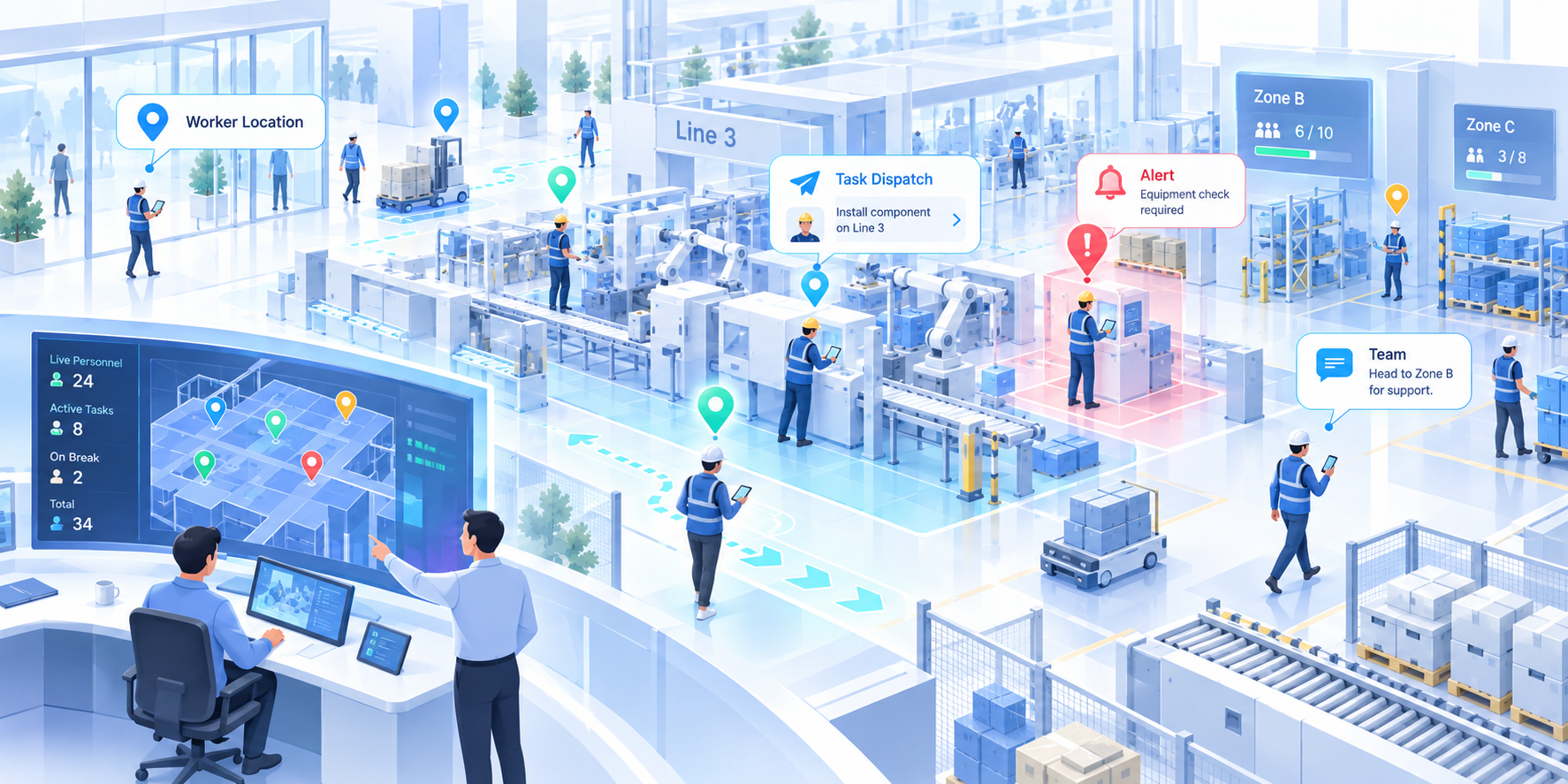
Indoor Tracking Systems for Manufacturing
Active Smart Transponders (Tags)
Compact, ultra-rugged tags affixed to pallets, heavy tooling, bins, forklifts, or worn as worker ID badges emit brief radio pulses containing micro-second timestamps.
Fixed Infrastructure Locators (Anchors)
Synchronized base stations mounted strategically overhead capture pulses across harsh industrial topologies, calculating flight metrics unaffected by environmental obstructions.
Positioning Engine & TDoA Algorithms
The centralized computing core utilizes Time Difference of Arrival (TDoA) algorithms to derive precise 2D/3D coordinates in sub-second intervals with high fault tolerance.
Industrial Application & Twin Integration
Processed spatial coordinates seamlessly integrate into Digital Twin platforms, MES, WMS, and ERP through standard REST APIs, MQTT, or OPC-UA protocols.
Core Application Modules Fueling Factory 4.0
Automated WIP & Order Journey Flow
Track order flow automatically as semi-finished goods glide across stamping, welding, and painting stations. Trigger automated MES stage confirmations without manual barcode scanning, guaranteeing an error-free digital audit trail for every manufactured SKU.
Intelligent Tool & Fixture Management
Prevent tooling attrition and calibration drift. Real-time location records map the exact bay, shelf, or CNC machine where dies and torque wrenches are stored. Automated alerts highlight tools nearing maintenance thresholds based on actual production transit cycles.
Virtual Geofencing & Hazard Mitigation
Enforce strict environmental safety zones. Automatically sound alarms when unauthorized line personnel enter robotic operating envelopes, or when an operator lacking hazardous-substance certification crosses into volatile chemical blending zones.
Why UWB RTLS Outclasses Bluetooth, Wi-Fi, and RFID Indoors
Industrial shop floors are severe RF environments dominated by dense steel machinery, electromagnetic noise, reflective walls, and fast-moving automated carriers. Under these punishing conditions, legacy wireless positioning protocols consistently fail.
The Physics of Ultra-Wideband (UWB)
Unlike Bluetooth Low Energy (BLE) or Wi-Fi, which rely on Received Signal Strength Indication (RSSI) to roughly estimate distance based on signal attenuation, UWB RTLS transmits nanosecond-duration radio pulses across an expansive frequency spectrum (3.1 GHz to 10.6 GHz).
Because these pulses feature extremely steep rising edges, UWB receivers easily differentiate direct Line-of-Sight (LoS) signals from multipath reflections bouncing off metallic press machines, storage racks, and concrete columns. This yields an unprecedented accuracy of 10 to 30 centimeters, compared to the 3 to 5-meter margin of error typical of legacy systems.
UWB Technical Advantages at a Glance
- Centimeter-Level Accuracy: Down to 10 cm, pinpointing specific shelf bins.
- Extreme Multipath Immunity: Reliable inside metal-dense stamping & machining plants.
- Ultra-Low Latency: Sub-second updates track dynamic AGVs and workers on the fly.
- High Channel Capacity: Concurrently tracks tens of thousands of active tags without RF collisions.
| Metric / Parameter | UWB RTLS (Industrial Standard) | BLE (Bluetooth Low Energy) | Passive RFID | Industrial Wi-Fi |
|---|---|---|---|---|
| Accuracy | 10 cm – 30 cm | 2 m – 5 m | Chokepoint / Proximity Only | 5 m – 15 m |
| Latency & Refresh Rate | Real-time (< 100 ms up to 50 Hz) | Moderate (1s – 5s) | Static (Only when manually scanned) | High Latency (3s – 10s) |
| Multipath Resistance (Metal/Walls) | Superior (Nanosecond RF Pulses) | Poor (High Signal Distortion) | Moderate (Blocked by metals/liquids) | Extremely Poor (Severe bounce) |
| Factory Use Cases | WIP, Tool Pinpointing, AGV, EHS | Rough Zone Presence, Office Pallets | Dock Door Entry/Exit Portal Logs | Coarse Asset Area Indication |
| Tag Battery Longevity | Up to 5–8 Years (Smart Power Mgmt) | 2–4 Years | Zero (Passive) / 3 Years (Active) | Days to Months (Heavy drain) |
Eforthink RTLS: Precision Engineered for Modern Manufacturing
Eforthink provides enterprise-grade, turnkey indoor tracking ecosystems combining military-spec industrial hardware, proprietary location engines, and agile open APIs designed for seamless industrial automation.
Tier-1 Vehicle Assembly Plant
A major automotive powertrain manufacturer struggled with missing custom engine engine carrier dollies across a 120,000 m² facility, generating continuous line stoppages.
Aerospace Component Fabrication
Specialized titanium milling requires strict torque tool calibration tracking and instant dispatching of specialized maintenance technicians across cavernous hangars.
Petrochemical & Hazardous Plant
A multi-building chemical facility required continuous worker location visibility, automated SOS alarms, and strict geofencing to prevent personnel entry into toxic reaction zones.
Unlock Transparent Factory Operations Today
Partner with Eforthink to engineer a high-precision, industrial-grade indoor tracking ecosystem tailored to your exact manufacturing landscape. Request an architectural blueprint and ROI projection customized for your operational footprint.