







UWB Asset Tracking for Complex Warehouses and Factories
Consumer finding devices have made distance-aware interactions more familiar. Industrial UWB asset tracking addresses a deployment requirement: maintaining location information for many identified tools, components and pieces of equipment across a site.
Warehouses contain dense shelving and changing stock, while factories combine metal machinery with moving resources. Reflections and shielding make coverage design important. UWB technology provides timing-based measurements that can support positioning, but the installation must be matched to the environment.
How UWB Supports Industrial Asset Visibility
Timing Resolution
Wideband signals provide detailed timing information that can help separate incoming signal paths. This supports UWB positioning in reflective environments. A direct path may still be blocked, and reflected paths can introduce error; multipath is managed through design and processing rather than completely eliminated.
Comparisons with other technologies should use the same business requirement. Identification at an entry point, zone detection and continuous equipment tracking are different tasks, with different installation and cost considerations.
Position Detail for Materials and Equipment
Eforthink describes 10–30 cm positioning capability for suitable UWB deployments. Actual performance depends on anchor geometry, obstruction, dimensionality and the statistical measure used in testing. That range should be verified for the intended installation.
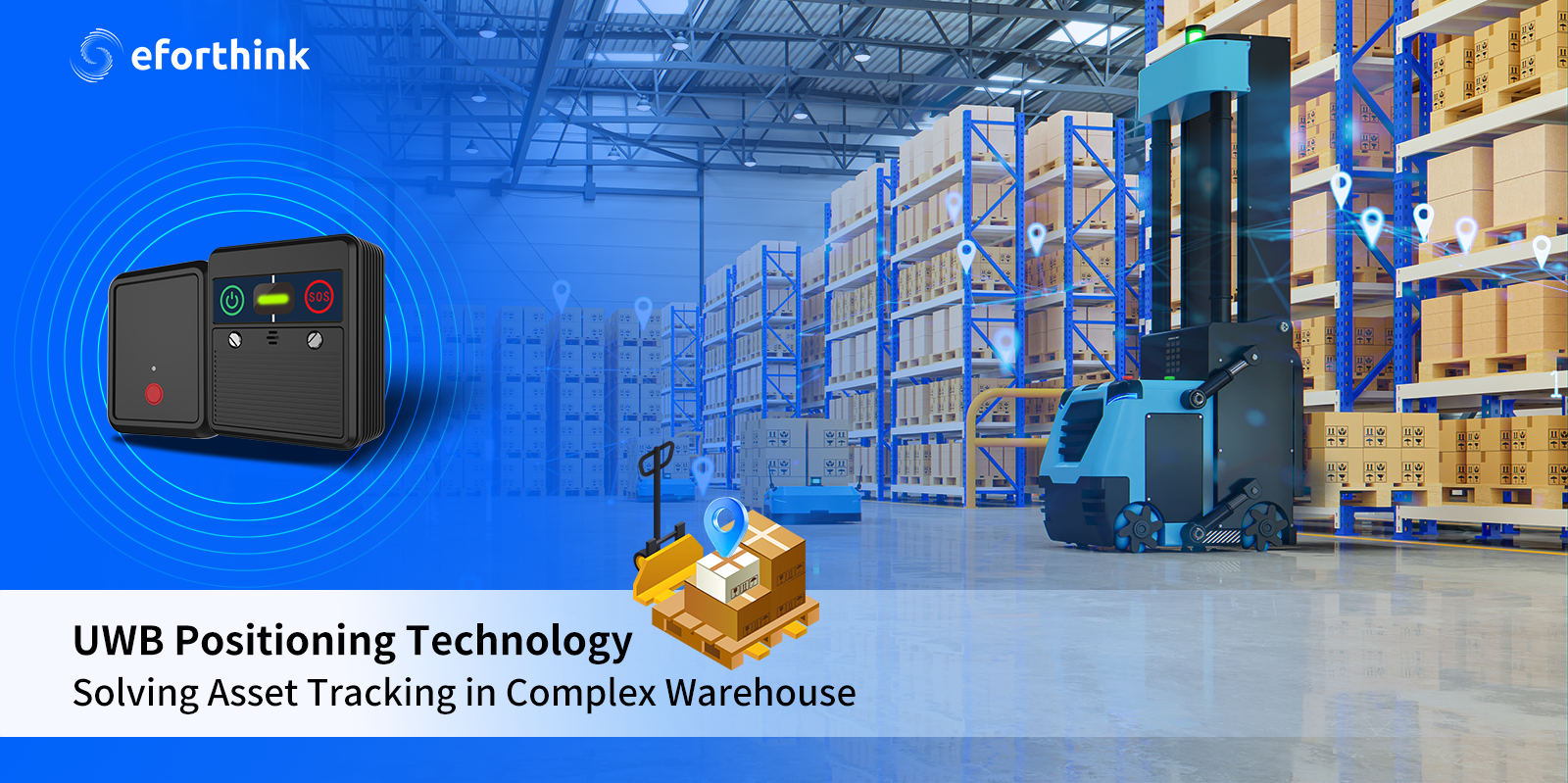
UWB asset tracking can help staff locate pallets, toolboxes and other tagged resources within coverage. It can also provide location information for assets transported by AGVs, where the tracked identifier and vehicle relationship are managed by the application.
Multiple Tags and Movement History
A deployment can support many asset tags, with capacity dependent on update rate, protocol and infrastructure. Position records can be associated with timestamps to support movement review and searches for an item’s last available observation.
Asset visibility depends on the records actually collected. History queries reflect the measurements collected and stored, including periods where observations are unavailable.
Updates for Moving Resources
UWB technology can support frequent position updates when the configuration and capacity allow. Equipment tracking requirements should specify the needed rate, end-to-end delay and acceptable gaps rather than assuming the same update frequency for every deployment.
Coexistence with on-site radios and moving loads should be assessed during site validation. Low transmit power alone does not guarantee interference-free operation.
Industrial Applications
UWB Asset Tracking for Goods
Installed anchors and tags associated with inventory identifiers support UWB asset tracking across covered storage areas. The application can display an item’s position and connect it with a warehouse record, helping staff conduct searches and stock checks.
Forklift and AGV Coordination
UWB positioning can supply vehicle locations for dispatch and route analysis when integrated with the operational platform. Vehicle control and collision-warning functions require their own interfaces and validation; a coordinate alone does not prevent congestion or a collision.
Monitoring High-Value Equipment
Equipment tracking can generate configured alerts when a tagged item moves outside an authorized area. These events help staff investigate possible misplacement or unauthorized movement, without guaranteeing theft prevention.
Contact Eforthink to discuss UWB asset tracking around your resources, site layout and operational workflows.