
UWB Indoor Navigation System for Commercial Complexes
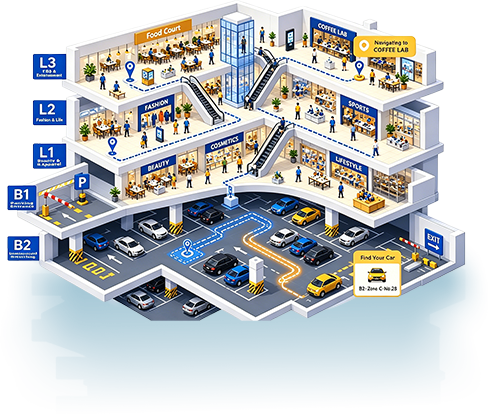
INDUSTRY CHALLENGES
APPLICATION OVERVIEW
SCENARIO COMPARISON
CORE FEATURES
KEY ADVANTAGES
COMPATIBLE HARDWARE
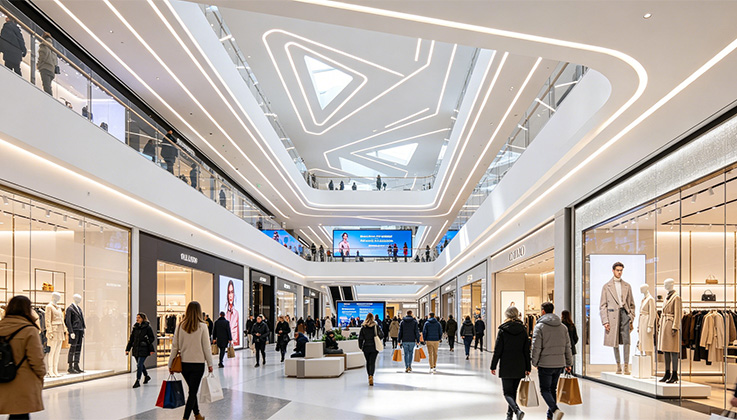
APPLICATION OVERVIEW

SCENARIO Comparison
Typical Scenario
Business Requirements

Bluetooth RSSI Positioning

Bluetooth AOA Positioning

UWB Smartphone Downlink Positioning (Recommended)
 Key Points
- High visitor traffic during weekends and holidays requires stable positioning for multiple users to ensure smooth navigation and services.
Key Points
- Bluetooth signal interference causes positioning drift and unstable performance under high user density.
Key Points
- Limited concurrency; large numbers of simultaneous users may increase system pressure.
Key Points
- ✓ Smartphone-based local computation eliminates server-side concurrency limitations, enabling stable positioning for large crowds.
Key Points
- Complex multi-floor environments require continuous navigation and accurate route guidance.
Key Points
- Limited accuracy makes floor-level identification difficult, causing navigation deviation.
Key Points
- Insufficient floor recognition capability; complex areas may require manual assistance.
Key Points
- ✓ Position calculated locally on smartphones without network dependency; supports seamless multi-floor navigation from entrance to destination.
Key Points
- Complex parking environments require accurate vehicle locating and navigation in weak-signal areas.
Key Points
- Dense lanes and signal interference cause positioning errors, making precise vehicle finding difficult.
Key Points
- Positioning performance decreases in weak-signal areas, affecting parking navigation experience.
Key Points
- ✓ Lane-level positioning with low latency, supporting accurate vehicle locating, reverse navigation, and offline operation.
Key Points
- Accurate customer location awareness is required for member engagement, targeted promotions, and customer analytics
Key Points
- Low positioning accuracy limits precise marketing applications and reduces data reliability.
Key Points
- Crowded environments increase recognition errors and reduce marketing data accuracy.
Key Points
- ✓ High-precision user location awareness with unlimited concurrency, enabling targeted notifications and location-based marketing.
Key Points
- Requires accurate customer flow analysis, heat maps, and data-driven decisions for refined mall operations.
Key Points
- Data accuracy is insufficient to support reliable operational decisions.
Key Points
- Deployment complexity and environmental limitations restrict data utilization.
Key Points
- ✓ Provides accurate spatial-temporal data for customer flow analysis, heat maps, and operational opti
Key Points
- Commercial spaces require fast deployment, aesthetic installation, and minimal impact on daily operations.
Key Points
- Requires large numbers of devices, affecting appearance and increasing maintenance costs.
Key Points
- Requires more base stations with complex installation and commissioning processes.
Key Points
- ✓ Longer coverage range with fewer base stations; faster deployment and no periodic calibration required.
Key Points
- Requires reliable long-term operation, low maintenance costs, and continuous service optimization.
Key Points
- Lacks centralized management capabilities and requires manual inspection for maintenance.
Key Points
- More infrastructure and environmental changes may affect accuracy, requiring continuous optimization.
Key Points
- ✓ Supports large-scale positioning and remote device management with lower maintenance costs and stable long-term operation.
CORE FEATURES
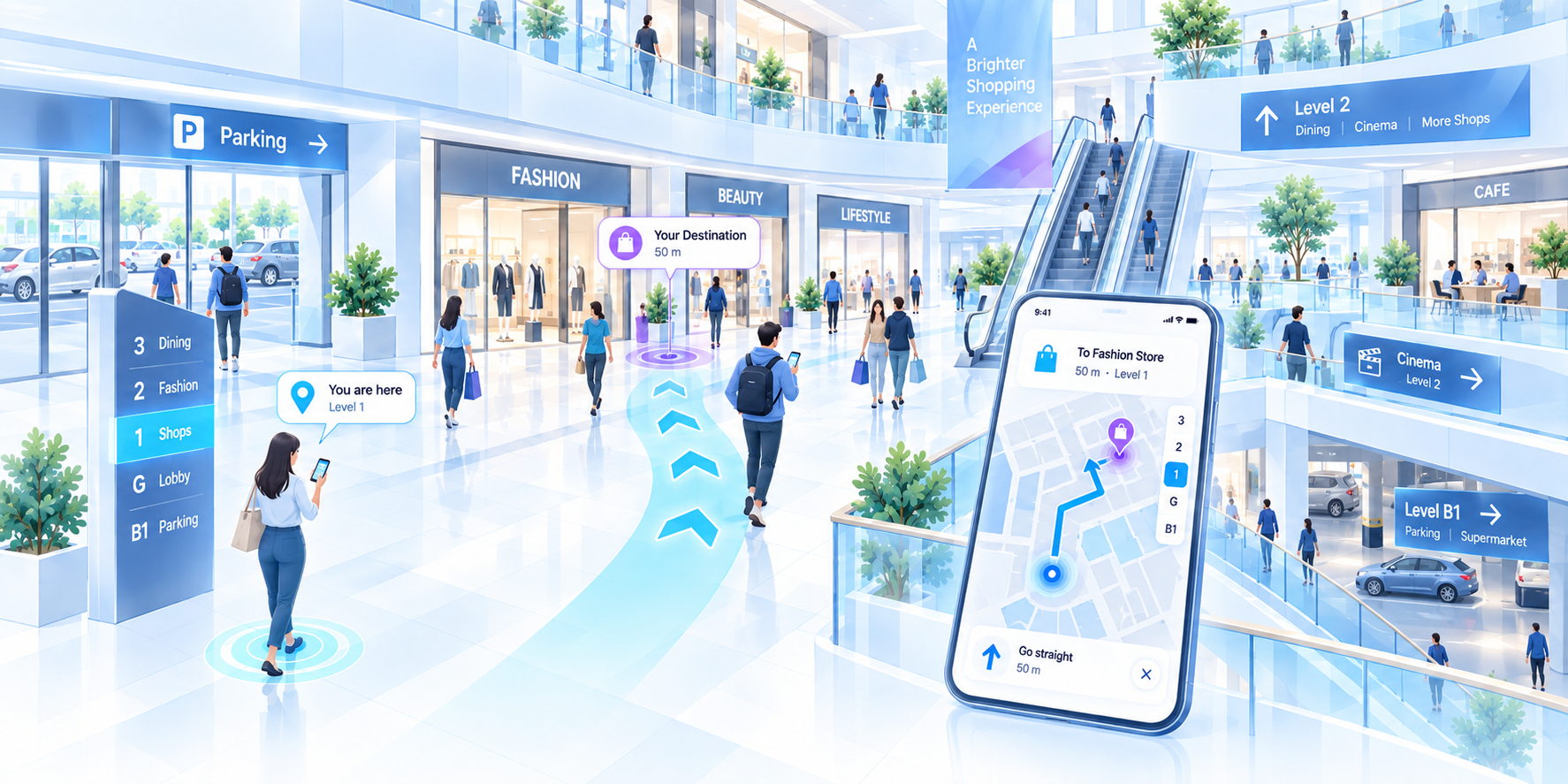
 Indoor Real-Time Positioning
Location Search
Route Planning
Store-Level Navigation
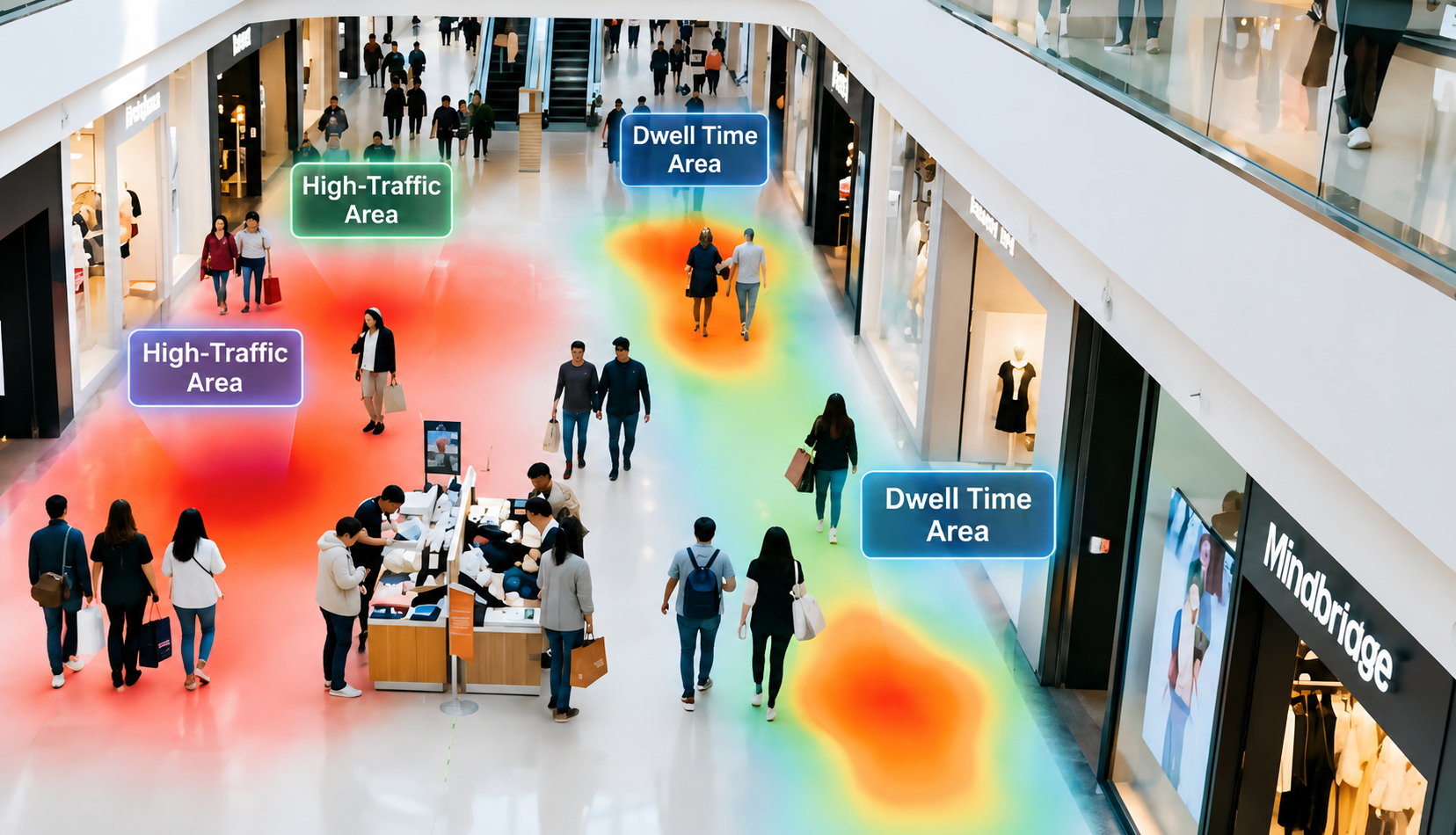
Area Distribution & Heatmaps
Precision Marketing Services
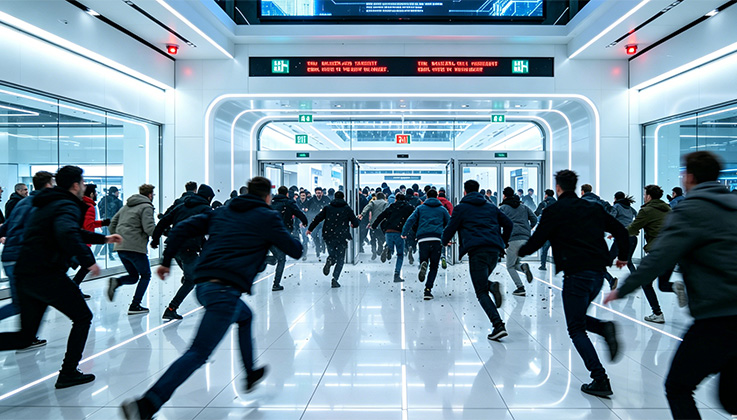
Emergency Evacuation
Indoor Real-Time Positioning
Location Search
![Indoor navigation system helping visitors search stores, facilities, parking destinations, restrooms, and exits in a shopping mall]()

Route Planning
![Indoor mapping and navigation planning multi-floor routes through elevators, escalators, corridors, and accessible paths in a commercial complex]()

Store-Level Navigation
![UWB indoor positioning guiding visitors precisely to store entrances and points of interest with arrival detection in a shopping mall]()

Area Distribution & Heatmaps
![Indoor location services showing visitor traffic heatmaps, dwell time, and area distribution across a commercial complex]()

Precision Marketing Services
![UWB navigation supporting location-based store information, nearby offers, and personalized promotions in a shopping mall]()

Delivery follows the user’s preferences and configured campaign rules.
Emergency Evacuation
![Indoor navigation system supporting emergency wayfinding, safe exit guidance, digital signage, and evacuation routes in a commercial complex]()

Where configured, guidance can be delivered through the app, digital signage, and public-address systems.




COMPATIBLE HARDWARE
Infrastructure Hardware
UWB Anchor Devices
UWB anchors provide the fixed downlink infrastructure for the commercial-complex deployment.
-
Eforthink UWB Indoor Wall-Mounted Positioning Base Station

Dimensions: 86.6x86.6 x36.0 mm
Power Interface: PoE
Antenna Type: Built-in onboard
Product Weight: ≤120 g
Rated SupplyVoltage: 48 V Standard PoE (802.3at)
Network Interface: RJ45 8-pin
Wired Data Interface: 10/100 Mbps adaptive LAN
Positioning Wireless Standard: IEEE 802.15.4-2015 UWB
-
Eforthink UWB Indoor Ceiling-Mounted Positioning Base Station

Dimensions: 96×96×40.5mm
Weight: 130 g
AntennaType: Built-in PCB antenna
Rated Power: 2.4W
Rated Supply Voltage: 48 V Standard PoE(IEEE 802.3at)
Network Interface: RJ45 8-pin
Wired Data Interface: 10/100 Mbps Adaptive LAN
Positioning Wireless Standard: IEEE 802.15.4-2015 UWB
Ecosystem Devices
UWB-Enabled Smartphones
One system, compatible with both iOS & Android ecosystems.
iOS Ecosystem
Coverage includes mainstream iPhone models: iPhone 12/ 13 / 14/ 15 / 16 / 17series
Strong ecosystem advantage with large installed base and mature UWB capability
Consistent user experience and ideal as primary coverage devices
Note: SE series and certain variants without UWB are excluded; availability depends on regional specifications
Android Ecosystem
Representative models: Xiaomi MIX 4, Xiaomi 17 Ultra, Xiaomi 17 Pro Max, Xiaomi 15S Pro, Samsung Galaxy S24 Ultra / S24+ / Z Fold5 / Z Fold6, etc.
Eligibility requirements: Built-in UWB chip + OS-level UWB support + project compatibility validation
Application characteristics: Highly fragmented device landscape with varying capability levels
Note: SE series and certain variants without UWB are excluded; availability depends on regional specifications