
UWB Indoor Navigation System for Exhibition Centers

INDUSTRY CHALLENGES
APPLICATION OVERVIEW
SCENARIO COMPARISON
CORE FEATURES
KEY ADVANTAGES
COMPATIBLE HARDWARE


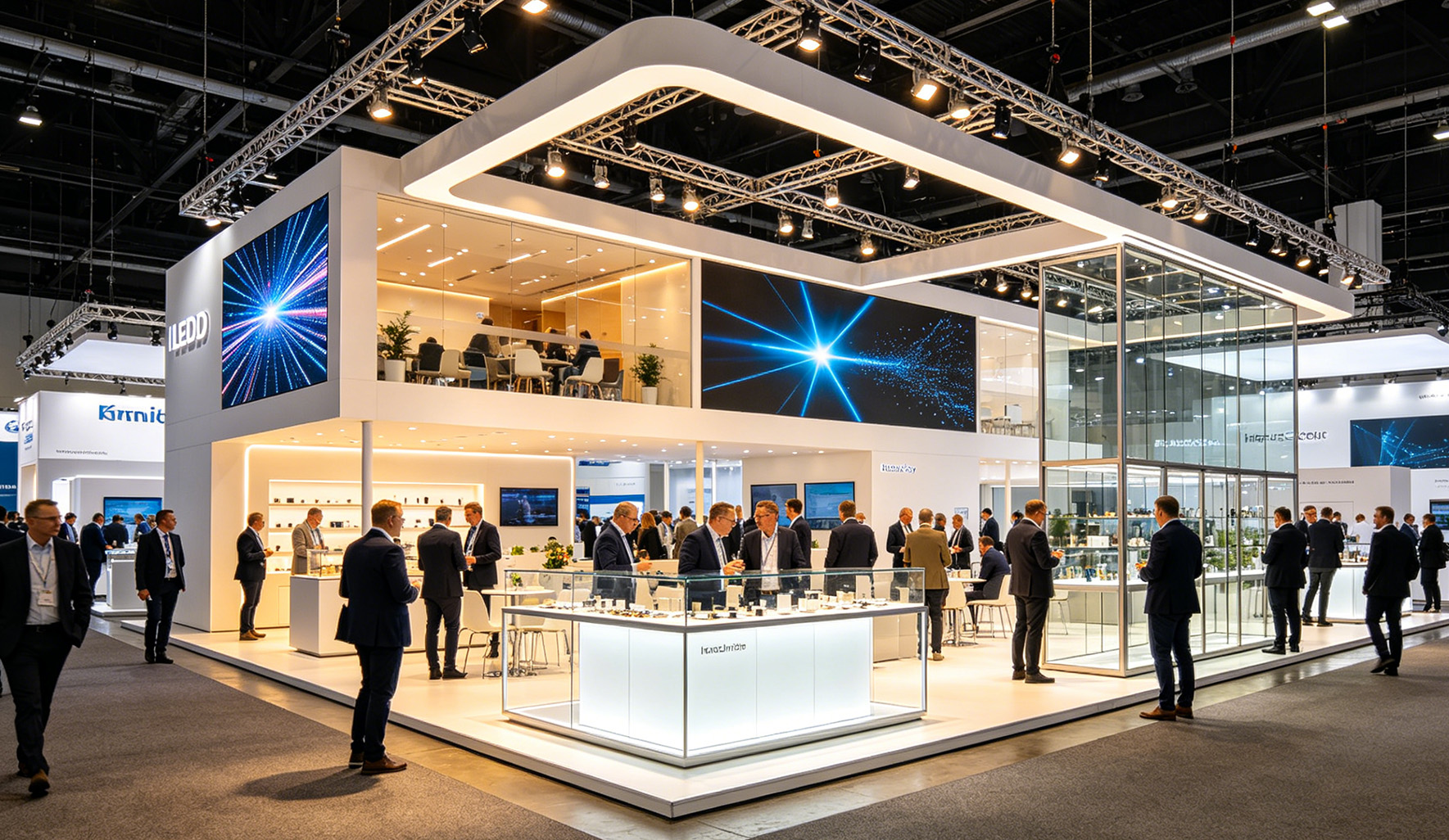
APPLICATION OVERVIEW
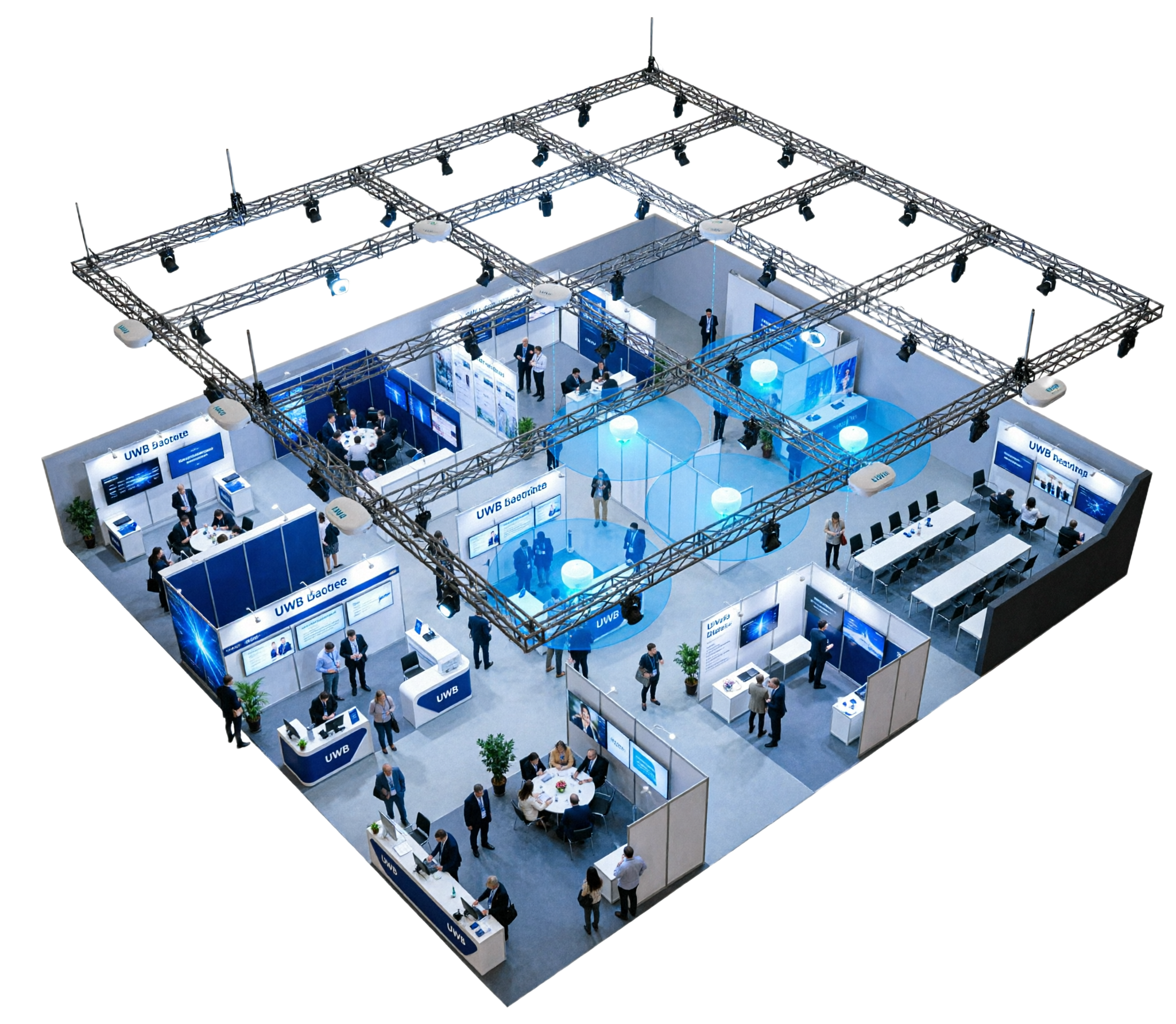
SCENARIO Comparison
Typical Scenario
Business Requirements
Bluetooth RSSI Positioning
Bluetooth AOA Positioning

UWB Smartphone Downlink Positioning (Recommended)
 Key Points
- Large venues with multiple halls, entrances, and booths require fast and accurate guidance from entrance to destination.
Key Points
- Provides only approximate location information; accuracy decreases in crowded environments, making precise navigation difficult.
Key Points
- Requires backend calculation; route updates are slower and nearby booths may be misidentified.
Key Points
- ✓ Booth-level positioning accuracy with local smartphone computation; fast route updates enable clear navigation from entrance to booth.
Key Points
- Popular booths may create congestion; organizers need real-time crowd awareness and route optimization.
Key Points
- Cannot accurately identify crowd distribution, making congestion response delayed.
Key Points
- Limited response capability during peak hours, affecting real-time guidance.
Key Points
- ✓ Real-time visibility of booth and aisle traffic; supports multiple users simultaneously and guides visitors through optimized routes.
Key Points
- Different visitors have different interests and require relevant recommendations instead of mass notifications.
Key Points
- Cannot identify specific booth visits or dwell locations, reducing recommendation accuracy.
Key Points
- Location data processing is slower, causing delayed recommendations.
Key Points
- ✓ Accurately identifies visitor location and dwell time, enabling personalized recommendations without unnecessary interruptions.
Key Points
- Exhibitors need visitor flow, dwell time, and engagement data to evaluate exhibition effectiveness.
Key Points
- Visitor statistics are inaccurate and cannot confirm actual visits or dwell behavior.
Key Points
- Data processing and interaction feedback may be delayed.
Key Points
- ✓ Provides accurate visitor trajectories, dwell time, and movement paths for detailed post-event analysis and ROI evaluation.
CORE FEATURES
 Booth Search & Route Navigation
Indoor Real-Time Positioning
Personalized Recommendations & Smart Guidance
Visitor Analytics & Heatmaps
Congestion Management & Safety Guidance
Smart Emergency Evacuation
Booth Search & Route Navigation
![Exhibition indoor navigation system guiding visitors to Booth A12 with real-time route planning inside a large exhibition center]()

Indoor Real-Time Positioning ![UWB indoor positioning in a large exhibition venue showing real-time location, floor recognition, and route guidance across multiple halls]()

Personalized Recommendations & Smart Guidance
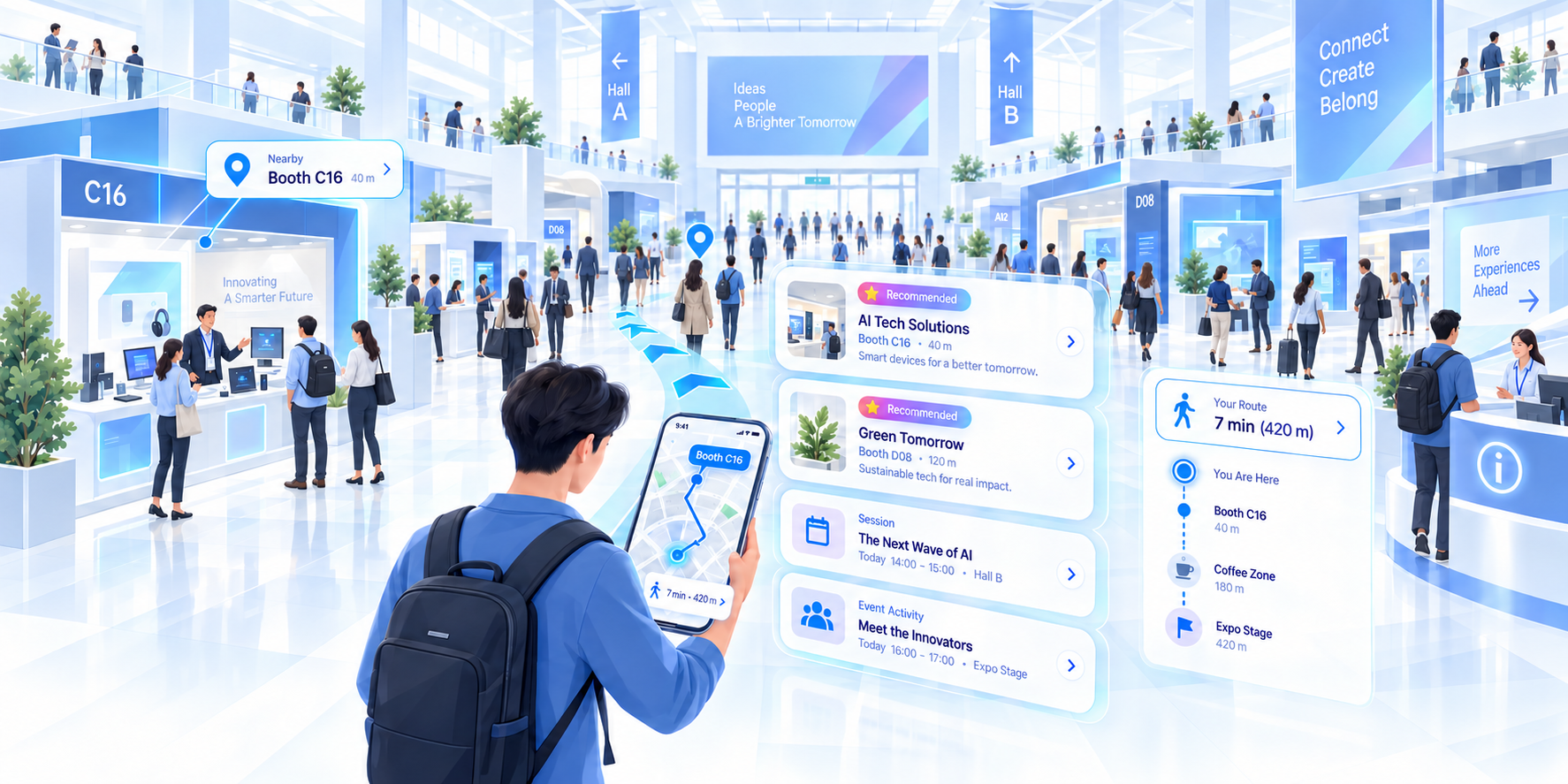
Visitor Analytics & Heatmaps![Exhibition visitor analytics dashboard with indoor location heatmaps, traffic flow, dwell time, and booth visit analysis]()

Congestion Management & Safety Guidance![Indoor navigation system for exhibition crowd guidance showing congestion monitoring, alternate routing, and safety navigation in real time]()

Smart Emergency Evacuation![Smart emergency evacuation in an exhibition center using indoor positioning, safe exit guidance, and real-time evacuation route navigation]()





COMPATIBLE HARDWARE
Infrastructure Hardware
UWB Anchor Devices
UWB anchors form the fixed positioning infrastructure for exhibition-center deployments.
-
Eforthink UWB Indoor Wall-Mounted Positioning Base Station
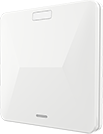
Dimensions: 86.6x86.6 x36.0 mm
Power Interface: PoE
Antenna Type: Built-in onboard antenna
Product Weight: ≤120 g
Rated SupplyVoltage: 48 V Standard PoE (802.3at)
Network Interface: RJ45 8-pin
Wired Data Interface: 10/100 Mbps adaptive LAN
Positioning Wireless Standard: IEEE 802.15.4_2015UWB
-
Eforthink UWB Indoor Ceiling-Mounted Positioning Base Station
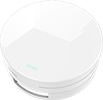
Dimensions: 96×96×40.5mm
Weight: 130 g
AntennaType: Built-in PCB antenna
Rated Power: 2.4W
Rated Supply Voltage: 48 V Standard PoE(IEEE 802.3at)
Network Interface: RJ45 8-pin
Wired Data Interface: 10/100 Mbps Adaptive LAN
Positioning Wireless Standard: IEEE 802.15.4-2015 UWB
Ecosystem Devices
UWB-Enabled Smartphones
Compatible UWB-enabled smartphones act as positioning terminals for the indoor navigation system.
iOS Ecosystem
Coverage includes mainstream iPhone models: iPhone 12/ 13 / 14/ 15 / 16 / 17series
Strong ecosystem advantage with large installed base and mature UWB capability
Consistent user experience and ideal as primary coverage devices
Note: SE series and certain variants without UWB are excluded; availability depends on regional specifications
Android Ecosystem
Representative models: Xiaomi MIX 4, Xiaomi 17 Ultra, Xiaomi 17 Pro Max, Xiaomi 15S Pro, Samsung Galaxy S24 Ultra / S24+ / Z Fold5 / Z Fold6, etc.
Eligibility requirements: Built-in UWB chip + OS-level UWB support + project compatibility validation
Application characteristics: Highly fragmented device landscape with varying capability levels
Note: SE series and certain variants without UWB are excluded; availability depends on regional specifications